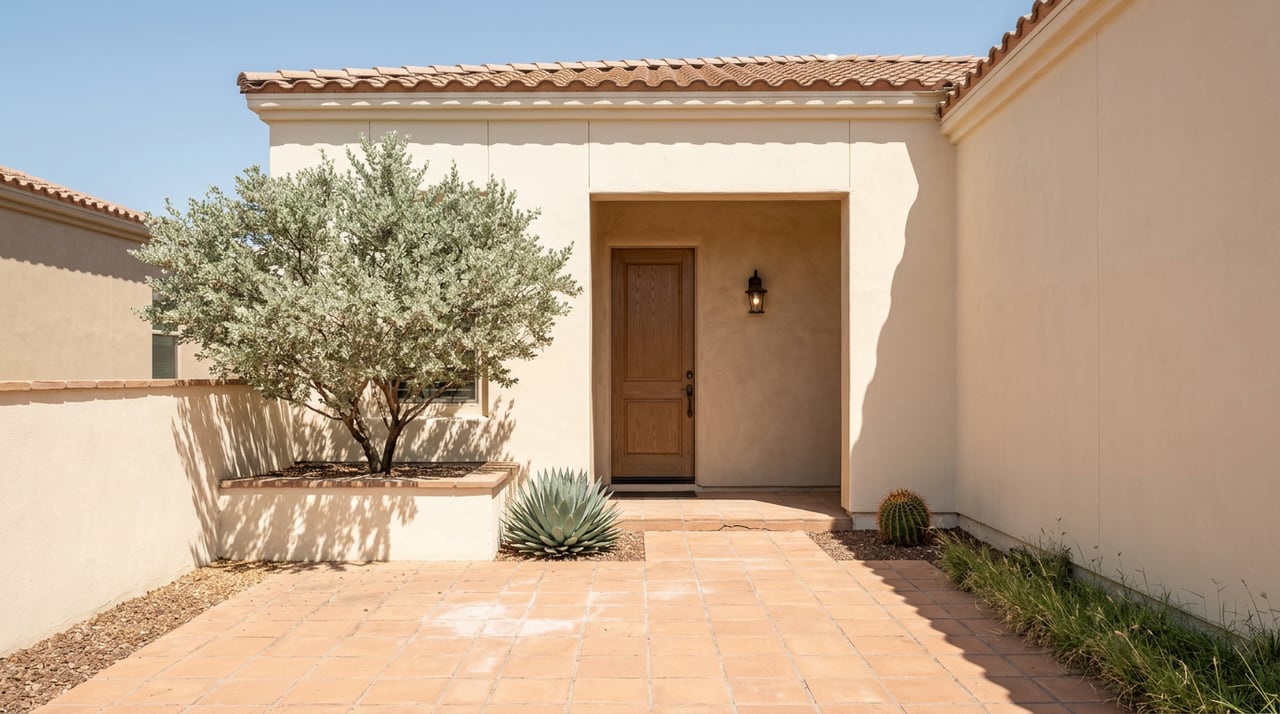
Sun City Oro Valley and Vistoso Village Share an Address, Not a Price Tag
August 20, 2026
August 20, 2026
Type "Sun City Vistoso" into a home search and you will pull up two different things that are not the same community. One is Sun City Oro Valley, the roughly 2,400-home Del Webb development that still carries "Sun City Vistoso" as its formal subdivision name on plenty of MLS listings even though its own marketing has moved on to "Sun City Oro Valley." The other is Vistoso Village, a separate 271-home gated community that sits immediately next door, uses the word Vistoso in its own name, and has nothing to do with the Sun City association beyond sharing a fence line and a zip code.
For a Tucson-area shopper this is a shrug. For someone comparing communities from Seattle or Chicago before a retirement move, it is the kind of mix-up that leads to touring the wrong gate or assuming two communities with overlapping names must have overlapping prices. They don't. And the reason they don't tells you more about what you're actually paying for in a 55+ purchase than the median price alone ever will.
Both Sun City Oro Valley and Vistoso Village sit inside Rancho Vistoso, the roughly 8,500-home master-planned community that spreads across the northern half of Oro Valley. The Vistoso Community Association, managed by FirstService Residential, runs the master layer for the whole footprint: the shared parks like Wildlife Ridge, Hohokam, and Honey Bee Canyon, the perimeter walls, the trail network. Layered on top of that master association, every gated subdivision and condo community inside Rancho Vistoso, including both age-restricted communities in question, runs its own separate sub-association with its own dues, its own reserve fund, and its own clubhouse to maintain.
That two-layer structure matters because it means the price difference between these two communities is not a Rancho Vistoso story. It's a sub-HOA story. You're comparing two separate products that happen to share the same master trails and the same mountain views.
Sun City Oro Valley was built by Del Webb between the late 1980s and mid-1990s across more than 1,000 acres. It has three recreation centers, an 18-hole golf course residents refer to as The Views, and close to 140 clubs covering everything from woodworking to genealogy. Vistoso Village was built later, between 1999 and 2005, as a gated enclave of 271 attached patio homes with a single clubhouse, a lap pool, a second pool and spa, and a quieter, more intimate footprint. It has no golf course of its own.
Neither community is better. They're built for different versions of a 55+ life.
A March 2026 neighborhood snapshot from Realtor.com put Sun City Oro Valley's median listing at $404,950 with 54 days on market, against Vistoso Village at $367,000 with 49 days on market. That roughly $38,000 gap on paper is the clean, same-source comparison. Closed sales tell a wider story once you get into early summer.
| Sun City Oro Valley | Vistoso Village | |
|---|---|---|
| Home count | ~2,400 | 271 |
| Built | Late 1980s to mid-1990s | 1999 to 2005 |
| Recreation | 3 rec centers, 18-hole golf, ~140 clubs | 1 clubhouse, lap pool, second pool and spa |
| June 2026 closed prices | Median $450,000 (range $320,000 to $650,000, 5 sales) | $324,000 to $405,000 (four closed sales, March through June) |
| Days on market (May 2026 snapshot) | 79 days average | Not separately tracked at same granularity |
The June 2026 numbers for Sun City show a $650,000 top sale against a $320,000 low, a spread that reflects golf-course lots and larger square footage pulling the median up. Vistoso Village's closed sales that same window topped out at $405,000, for its largest available floor plan at 1,851 square feet, the biggest unit the community has ever offered.
That ceiling is not a coincidence. It's structural.
Vistoso Village sold out of new construction in 2005. Every home that trades hands there today is a resale of one of five original floor plans, ranging from 1,170 to 1,851 square feet. There is no builder coming in to add a sixth floor plan or a larger unit next year. The community's entire inventory was fixed twenty years ago.
Sun City Oro Valley, by contrast, has a wider range of original floor plans and, because it's larger and older, a wider spread of renovation levels, lot types, and golf-course proximity feeding its resale market. That range is what produces both the $320,000 entry point and the $650,000 top sale in the same month of closed data.
If you're comparing these two purely on "what does my money buy," the honest answer is: at Vistoso Village, you're buying a known, capped product with a smaller HOA and a quieter, no-golf lifestyle. At Sun City Oro Valley, you're buying into a bigger, more amenity-dense community where price is doing more work to sort golf-course lots from interior lots, and renovated homes from original 1990s finishes.
Here's the practical friction. As of a May 2026 pull of active listings, Sun City Oro Valley properties were still showing up under subdivision names like "Sun City Vistoso Unit 3" and "Sun City Vistoso Unit 5" on public search sites, a holdover from before the community's rebrand. Meanwhile Vistoso Village markets itself, accurately, as sitting immediately adjacent to that same Sun City community, while operating as a completely independent, separately governed HOA with its own clubhouse and its own board.
For a local buyer, none of this matters because everyone already knows which gate is which. For an out-of-state buyer building a shortlist from a laptop, the overlapping Vistoso naming and the legacy Sun City Vistoso subdivision codes can blur two communities that don't share a price range, an amenity package, or a governing board. The fix is simple but easy to skip: confirm the actual HOA name and the actual address before you assume two listings with similar names are describing the same lifestyle.
If golf, a large activity calendar, and a wider range of home sizes and price points matter more to you than a small footprint, Sun City Oro Valley's roughly 2,400-home scale gives you more resale inventory to choose from at any given time, including the occasional $320,000 entry point alongside the $650,000 golf-course homes. If a smaller, quieter community with a fixed, known inventory and lower turnover appeals more, Vistoso Village's resale-only structure means you're choosing from a stable, capped set of floor plans that will not expand, for better or worse.
Either way, the two communities are not interchangeable just because a search engine or an old subdivision code says otherwise. Confirming which HOA actually governs a specific address, and what that association's dues cover, is worth doing before you fall for a listing photo.
If you're weighing a move into Rancho Vistoso's 55+ communities, or trying to figure out which one actually fits the retirement you're picturing, Art Lopez can walk you through the current inventory in both communities and help you sort out which HOA you're really buying into. Let's Connect.

The story it tells about Canada Hills is more useful than either number in isolation.

A guide for residents who already know the shortcuts through Innovation Park.

Here’s what homeowners and buyers should know about today’s market.
If you’re thinking about selling or just exploring your options, let’s connect. I’m here to help you make informed decisions and get the most from your investment.